Story by: Maurizio Lazzari, Maria Carmela Grano
Drone Footage: Francesco Giuri
Drone Footage: Francesco Giuri
Filming Locations:
San Martino d’Agri, Tito, Picerno, Terranova di Pollino — Basilicata, Italy
San Martino d’Agri, Tito, Picerno, Terranova di Pollino — Basilicata, Italy
Short Synopsis
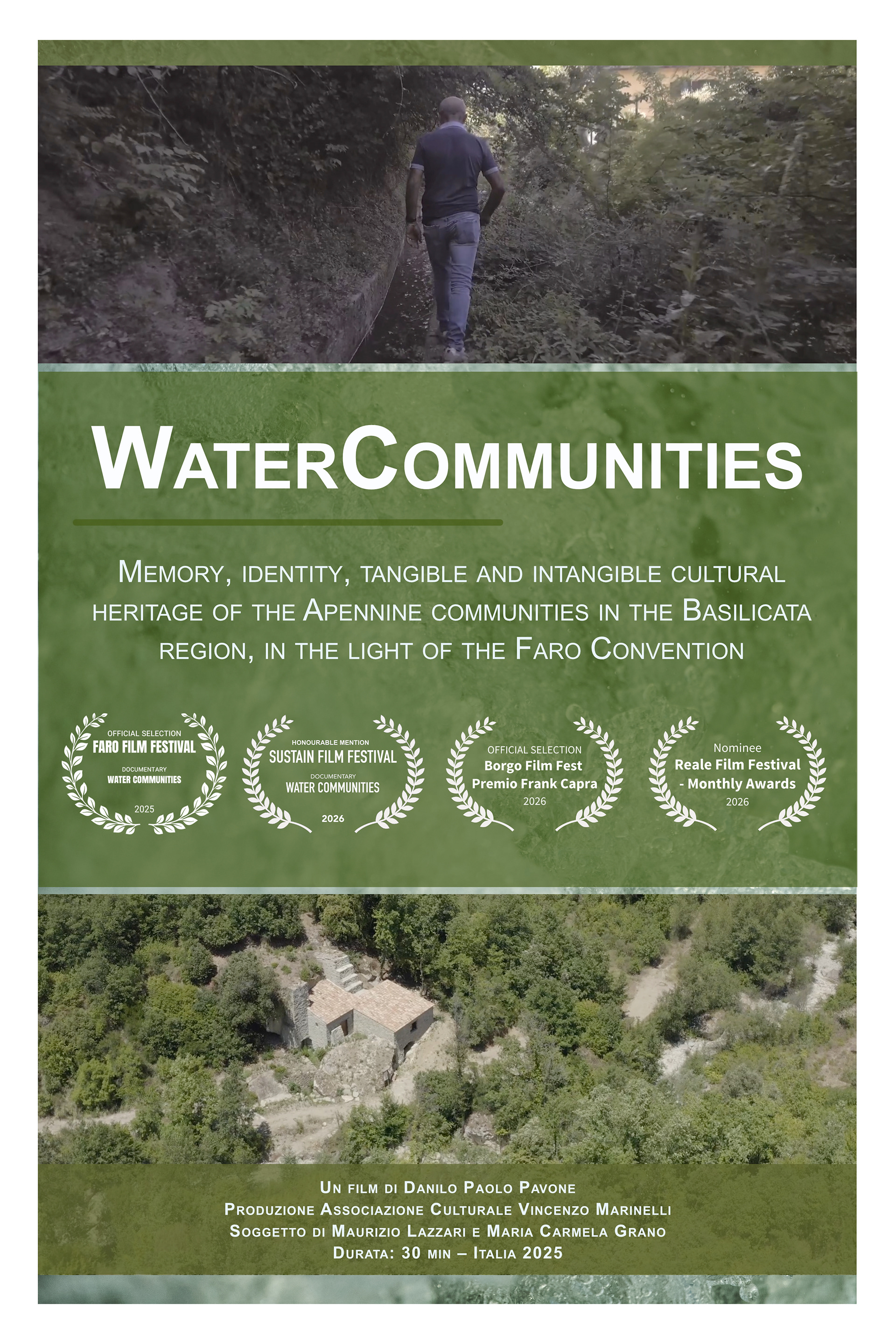
The documentary intertwines stories and testimonies from the Basilicata region — in the villages of San Martino d’Agri, Tito, Picerno, and Terranova di Pollino — to reconstruct the deep bond between the inhabitants and water: a source of life, labor, and identity, as well as a keeper of childhood memories and untouched landscapes.
The project draws inspiration from the scientific research conducted by CNR scholars Maurizio Lazzari and Maria Carmela Grano on the documentation of traditional watermills across the Basilicata region and on the social impact that these activities continue to generate within local communities. Their work provides an essential framework for understanding water heritage not only as a historical resource, but also as a living element of cultural identity and collective participation.
From the mill and the fulling mill — once the engines of a water-based economy — to the gardens still irrigated by the river’s canals, the story unfolds as a collective narration where past and present engage in dialogue.
At its core are the shared and participatory actions of the inhabitants who live in and care for their territory — understood not only as land but as a place of knowledge, memory, and tradition — with the intent to preserve and pass it on to future generations.
Thus, memory becomes action, and heritage transforms into an identity resource, embodying the spirit of the Faro Convention.